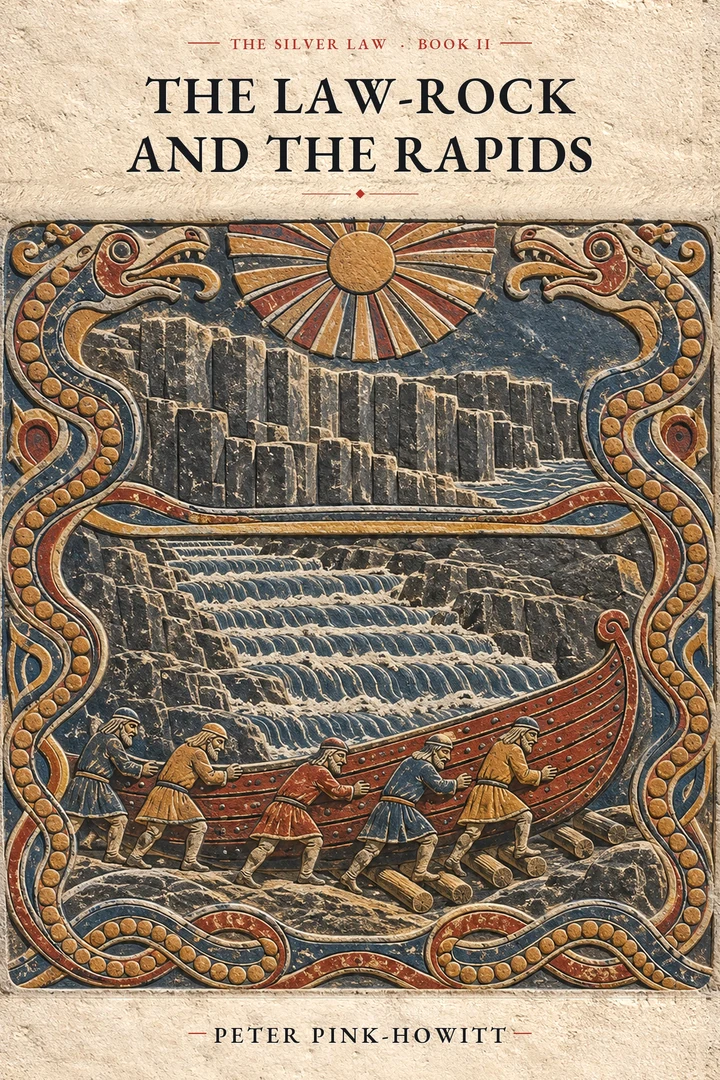
The Law-Rock and the Rapids (Provisional)
Vaðmál Credit, Confiscation Courts & the Seven Dnieper Cataracts · Breiðafjörðr & Þingvellir <-> Aldeigjuborg -> Seven Dnieper Cataracts -> Miklagarðr
Volume II Dossier Guarded Behind Reading Horizon 2
Sixty-two winters after the first Icelandic land-claims, the fissure eruption of Eldgjá (939–940 CE) veils northern skies in sulphurous red haze. Across two water-roads — Iceland's kingless volcanic valleys and the granite cataracts of the lower Dnieper — households discover what happens when spoken law and sworn commercial partnerships stretch across bad summers.
Sixty-two winters after the first Icelandic land-claims, the fissure eruption of Eldgjá (939–940 CE) veils northern skies in sulphurous red haze. Across two water-roads — Iceland's kingless volcanic valleys and the granite cataracts of the lower Dnieper — households discover what happens when spoken law and sworn commercial partnerships stretch across bad summers.
Unsealed at Horizon II: Under the failing grass of the 940 CE Eldgjá frost-summer, Þórunn's granddaughter defends the household's warp-weighted vaðmál loom-mint and one-third goðorð chieftaincy share across Lögberg and a fourteen-night féránsdómr confiscation stand-off one bowshot from the farm wall. Simultaneously, her brother Ragnvaldr Vésteinsson carries the blade-nicked 22.8-gram Torksey scale-set down the Volkhov and past Constantine VII's seven bilingual Dnieper rapids, marching chained captives six miles overland at Aeifor under Pecheneg bowshot to trade beneath the 944 CE Russo-Byzantine silk ceiling and carve the Berezan félagi slab.
Perspective Bearers
- Hallbera Vésteinsdóttir — Breiðafjörðr weaver-litigant defending a one-third goðorð share and household vaðmál credit during the Eldgjá famine.
- Ragnvaldr Vésteinsson — Eastern-Road félagi carrying the 22.8 g poise across Gnezdovo's rollers and the six-mile Aeifor portage to St Mamas.

- Eldgjá flood-lava eruption (939–940 CE) verified in Greenland ice cores and northern tree-ring frost narrows.
- Constantine VII Porphyrogenitus, De Administrando Imperio ch. 9 (c. 948–952 CE), and Gotland's Pilgårds stone G 280 ('aifur').
- Russo-Byzantine Treaty of 944 CE: St Mamas seasonal quarters and 50-nomismata lead-sealed silk cap.